
Size storage from daily kWh, peak loads, solar production and reserve days rather than battery capacity in isolation.
Solar & Off-Grid
LiFePO4 storage for solar and off-grid power systems
Build storage around daily consumption, solar production, inverter power and the autonomy you need when the grid is not part of the plan.
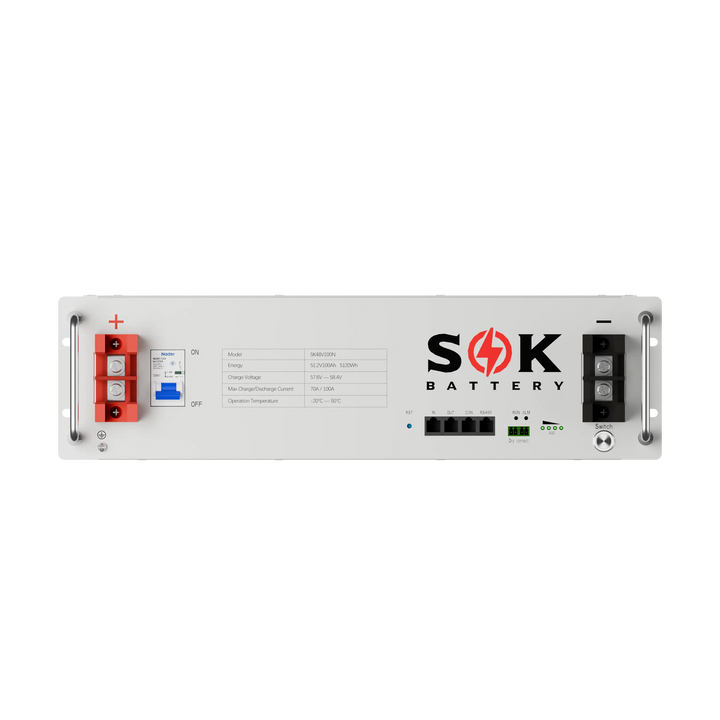
SOK 48V rack battery options are designed for larger solar-storage and off-grid architectures.
CAN and RS485 on compatible models support integration with selected inverter and monitoring ecosystems.
A modular battery approach can make capacity expansion and long-term system servicing more practical when designed correctly.
Recommended for
Solar & Off-Grid
View all →
Recommended solar storage batteries
System planning
Choose the voltage that fits your system
Start with your inverter, charging sources, loads and existing electrical architecture. For multi-battery systems, confirm model compatibility before installation.
Why SOK
Storage should follow the energy flow of the whole system
Start with load profile, inverter voltage, PV array, charge controllers and desired autonomy. Communication compatibility and parallel limits must be checked against the exact battery and inverter combination.
Discuss your system →Selected SOK models use serviceable construction to make long-term ownership and component access more practical.
Selected models offer self-heating for charging in cold conditions; operating limits remain model-specific.
Bluetooth, CAN and RS485 availability varies by model for monitoring and system integration.
Selected models support Victron-compatible communication for integrated battery monitoring and system control.
Buying guide
Questions before you choose
Model specifications differ. Use these answers as a starting point, then check the product page or contact SOK for a system-specific recommendation.
How much battery storage do I need for an off-grid system?
Estimate daily kWh consumption, decide how many low-solar days you want to cover, then account for inverter losses and your usable reserve. Charging capacity must also be large enough to refill the bank.
Is 48V better for larger solar systems?
48V is commonly used for larger inverter and storage systems because it can reduce current for the same power level. The best system voltage still depends on your inverter and overall design.
Can SOK communicate with my inverter?
Compatibility depends on the exact battery and inverter model. Selected SOK products provide CAN and/or RS485; verify the supported protocol before purchase.
Can I expand the battery bank later?
Expansion can be possible within the model-specific parallel limits. Plan cable sizing, protection, state of charge and battery age carefully, and confirm the intended configuration before adding batteries.
Need help choosing?