_edited.jpg)
LiFePO4 Battery Not Charging? How to Recover After Deep Discharge
- SOK Battery

- Jul 14
- 4 min read
Most “dead” lithium iron phosphate batteries after a deep discharge are caused by the BMS entering protection mode, not by immediate battery failure. Follow the steps below to diagnose and wake up your battery before contacting support.
Why is my SOK LiFePO4 battery not charging after a deep discharge?
If a LiFePO4 battery is deeply discharged and left without charging for an extended period, the Battery Management System (BMS) may enter a protection state to prevent further damage.
In some cases, the battery may appear completely inactive:
1. No output voltage
2. The charger shows no charging current
3. The Bluetooth app cannot connect
4. Battery appears “dead”
Don't panic—this does not mean your battery is permanently damaged. The battery may need to be reactivated.
Step 1: Check the battery voltage
Before attempting recovery, please check the battery voltage:
Disconnect all loads and chargers from the battery.
Use a multimeter to measure the voltage directly from the battery terminals.
Terminal Voltage Reading | Possible Condition |
Above 12V | The lithium battery may be in BMS protection mode |
10V-12V | The lithium battery may be deeply discharged and require recovery |
Below 5V | The BMS may not have enough voltage to activate normally |
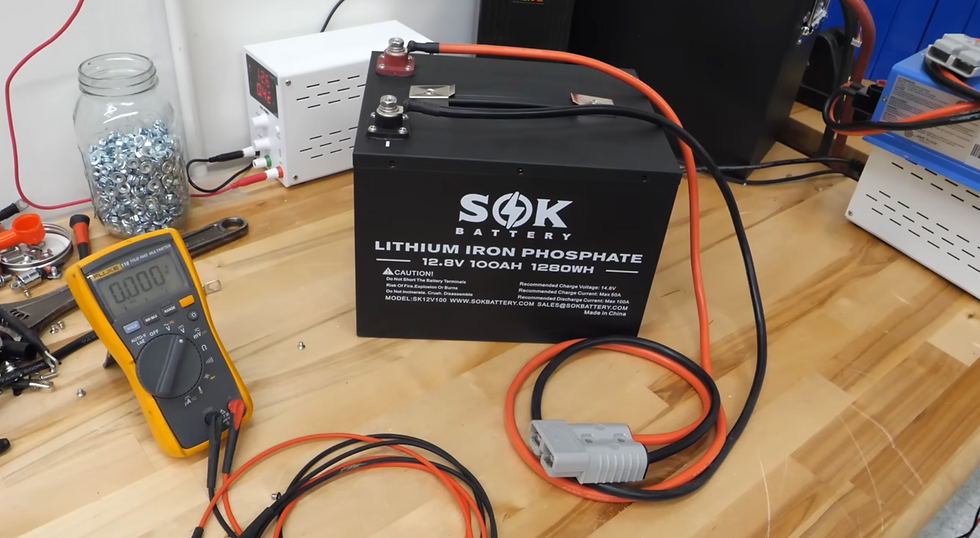
Step 2: How to Wake Up the BMS
When a LiFePO4 battery is deeply discharged, the BMS may enter low-voltage protection mode and disconnect the battery to protect the cells. Some chargers may not recognize the battery because no voltage is detected.
Option A: Temporary Voltage Activation
Use a fully charged 12V battery (a 12V LiFePO₄ battery is recommended).
Connect the positive (+) terminal of the charged battery to the positive (+) terminal of the SOK battery.
Connect the negative (-) terminals in the same way.
Keep the connection for about 5–10 seconds.
Disconnect the temporary battery and immediately connect your LiFePO₄ charger to the SOK battery.
If the BMS has recovered, the charger should begin charging normally.
Note: This method is only for waking up the BMS. Do not leave the batteries connected together for charging.
Option B: Use a Lithium Charger with Recovery Function
Some lithium chargers and MPPT controllers support a 0V activation or battery recovery function.
Connect the charger and select the LiFePO₄/lithium charging profile. Allow the charger to attempt recovery for 15–30 minutes.
If the Lithium Battery Still Won't Charge
If the battery still cannot accept a charge after attempting the BMS wake-up methods, please check the battery voltage again with a multimeter.
If the voltage remains at 0V, drops back to 0V shortly after activation, or stays below 8V and the charger does not provide any charging current, the battery may have been deeply discharged for an extended period and requires further evaluation.
Please contact SOK Europe Support and provide the following information so we can help diagnose the issue and recommend the next steps:
Your battery model (e.g., 12V 100Ah / 206Ah)
The exact voltage reading you got from the multimeter
The brand and model of your charger/solar controller
Roughly how long the battery remained in a discharged state
FAQs about Charging Lithium Batteries
How to prevent deep discharge in the future?
To protect your SOK LiFePO4 battery:
Recharge the battery promptly after use.
Avoid leaving the battery in a fully discharged state for extended periods.
For long-term storage, keep the battery at around 50% state of charge (SOC).
Disconnect unnecessary loads during storage to prevent slow discharge from external devices.
What are the warning signs of a failing SOK LiFePO4 battery?
Apart from a total loss of charge, a battery nearing the end of its lifespan or suffering from internal stress will show clear red flags: a sudden, drastic drop in daily runtime, physical swelling or bulging of the casing, or excessive heat buildup during standard operation.
Note for SOK Users: Thanks to our signature user-serviceable case design, if you notice unusual behavior but the outer casing is fully intact, the issue might simply be an out-of-spec cell or a standalone BMS component rather than a dead battery.
Compared with permanently sealed battery designs, SOK’s user-serviceable design allows easier inspection, troubleshooting, and component replacement when needed. However, if you detect severe case warping, leaking, or a burnt odor, disconnect the system immediately and contact our support team.
What is the maximum storage time for an uncharged SOK battery?
If a LiFePO4 battery is deeply discharged and the voltage drops too low, it should be recharged as soon as possible to prevent long-term cell damage.
However, for seasonal storage (such as winterizing your RV or off-grid cabin), SOK batteries boast an exceptionally low self-discharge rate. When properly prepared—charged to 50% – 80% State of Charge (SOC) and completely disconnected from all external parasitic loads—the battery can safely hibernate for 6 to 12 months.
For maximum longevity and peace of mind, we recommend a quick top-off check every 6 months to ensure the system remains in a healthy voltage zone.
Why does my charger stop before reaching the absolute full-charge voltage?
This is normal behavior for LiFePO4 batteries. As the battery approaches full charge, the cell voltage rises quickly near the top of the charging curve, and the charger gradually reduces the charging current during the final charging stage.
The SOK BMS continuously monitors individual cell voltage and provides protection and balancing functions to maintain safe operation.
After charging stops, the battery voltage will naturally settle to its resting voltage. For a 12V LiFePO4 battery, a resting voltage around 13.4V–13.6V is normal.
A slightly lower resting voltage after charging does not mean the battery is not fully charged.


Comments